
Why Does John Deere Want to Extend a 6-Year Contract?
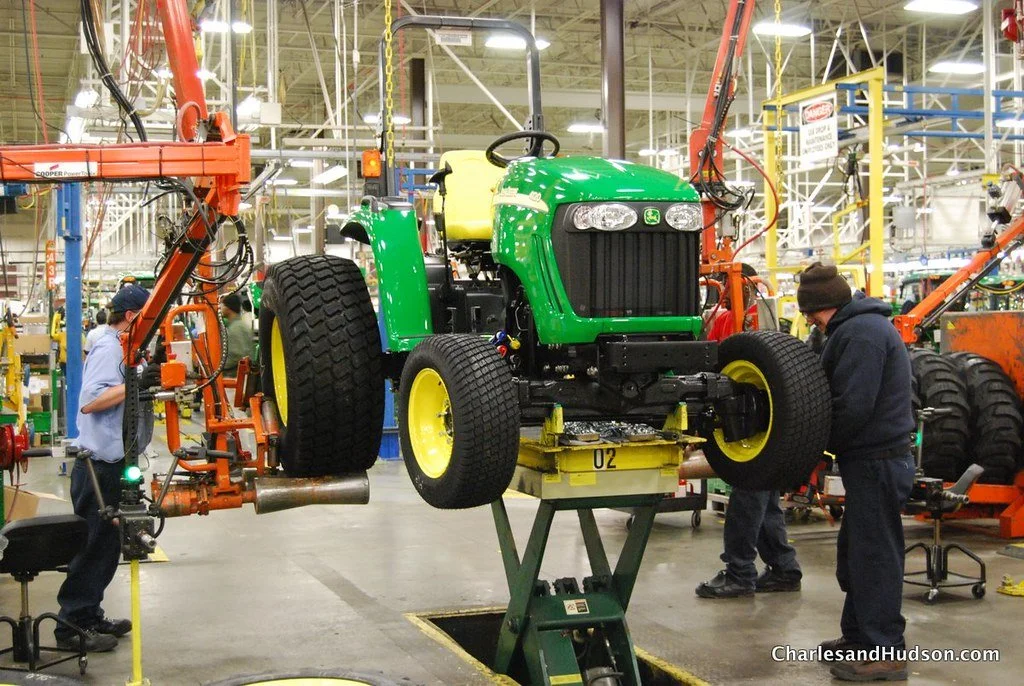
UAW members working at John Deere face a decision — accept a contract extension that would push negotiations off until 2029, or get ready to fight in 2027.
Photo by Charles and Hudson, CC BY-SA 2.0
Yesterday, President Tim Cummings of UAW Local 838, representing John Deere workers in Waterloo, Iowa, announced that the company is proposing a two-year extension of their current contract. The agreement covering over 10,000 Deere workers spanning nine UAW locals is set to expire in October 2027 and will already have been in effect for six years. While the new proposal does not include changes to benefits or other contract terms, it does include a 4% general wage increase this and next November. The company also tied a $3,000 signing bonus to the offer.
The last contract fight at Deere in 2021 resulted in one of the largest strikes a private sector employer had seen in years. UAW members rejected multiple tentative agreements and struck for almost five weeks, winning back COLA along with improved raises and benefits.
Why Does Deere Want to Extend the Contract?
While no reason for the offer was given in the update from Local 838, it is clearly a sign that the company prefers to avoid bargaining next year. The agricultural equipment industry faces a downturn after several years of record demand. Uncertainty in global agricultural markets, along with other economic factors, has caused farmers to delay equipment purchases.
However, Deere has remained highly profitable throughout this contract cycle. The company reported more than $5 billion in net profits last year, and even more in previous years — bringing in over $10 billion in 2023.
Workers are speculating that Deere is preparing to stockpile inventory, offshore production, or both. The two-year extension would allow Deere to build enough inventory ahead of a potential strike or lockout. It could also give the company time to expand overseas production to countries with cheaper labor costs that may also be important growth markets for the company, such as Brazil.
Those concerns are heightened by the limits of the current job security language in our Deere contract. Compared to the Big 3 contracts, which lay out investment plans down to specific products and grant workers the right to strike over investment and plant closures, the master Deere contract has weaker protections. They do include a moratorium on plant closures, however, that language does not necessarily protect against product “unallocation” or other company workarounds.
Another possibility is that Deere is attempting to circumvent the opportunity for workers to unify and build a contract campaign — a strategy UAW members have deployed to win record gains elsewhere. The 2021 Deere strike impacted production and profits, and Deere surely wants to avert another strike in 2027.
“[Deere is] banking on immediate financial pressures facing individual members — mortgages, inflation, family expenses — to secure a yes vote before we have a chance to build a unified, aggressive bargaining plan” says Jake Lane from Des Moines, Iowa, Local 450.
By making this offer more than a year out from negotiations, Deere is first to the draw and can set their own terms before our union has been able to prepare. Members have not been surveyed on which issues they would like to see addressed. Some locals have not even elected bargainers to serve on the UAW Deere Council for the negotiations.
What Comes Next?
“This was not a negotiation and this was never initiated by the union,” says the Local 838 President in his update. UAW negotiators are not required to bring the proposal to a vote of the members. However, the update suggests that a ratification vote across Deere locals is already in the works.
Deere workers will ultimately decide whether to extend their current contract by two years, or reject the company’s proposal and prepare for bargaining next year. While it’s hard to imagine that the company’s first offer is the best deal on the table, the bigger question is when workers’ leverage will be strongest. Will turbulent conditions make for difficult terrain for workers and management alike to negotiate next fall? Or is Deere trying to short-circuit the 2027 bargaining process by locking in an extension before members have time to unite around priorities and build momentum?
